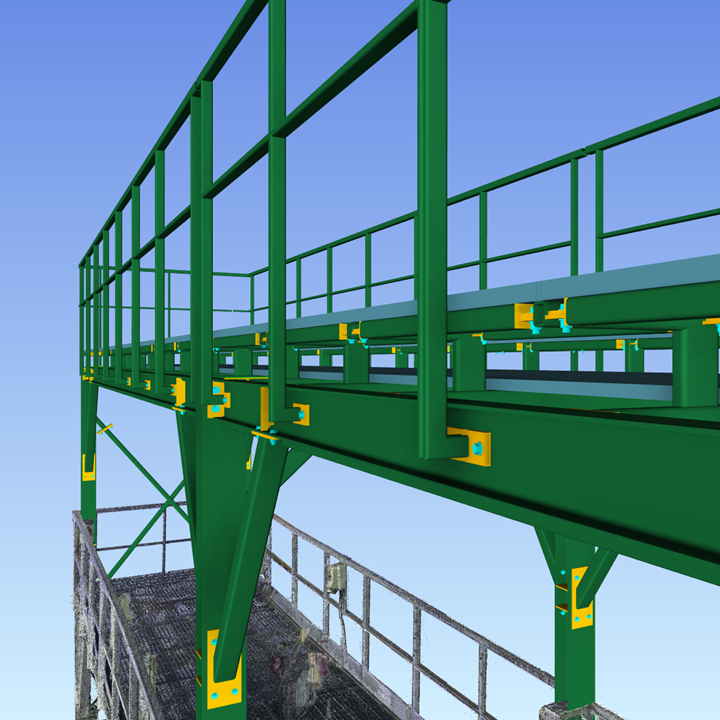


3D laser scan pointcloud to 3D CAD conversions
Using CAD software tools, we convert laser scan point clouds into accurate 3D models of Architectural, MEP, and Process components of industrial facilities.

Reverse Engineering
Using 3D laser measurements, we produce accurate technical documentation for hardware elements and equipment in industrial plants.

Accurate and Detailed DWG architectural documentation
Preserve our cultural heritage with precision!
Floor Plans | Sections | Site plans | Details
Using point clouds generated from 3D laser scanning or photogrammetry, we create highly accurate 2D plans of existing buildings, rooms, structures, and elements. For this work, we primarily use Autodesk software tools, including AutoCAD, Revit, and Civil.
We produce technical plans for all types of industrial buildings as well as structures under monument protection. Our plans can be millimeter-accurate, or we can adjust the accuracy and level of detail based on the client’s requirements.
We can work with the client’s existing templates for layouts, or we can create new ones and equip them with standardized measurements, layers, and pre-prepared plotting sheets.
As an outsourcing partner, we also convert point clouds into 2D plans for foreign 3D scanning suppliers. Our clients come from EU countries and the USA, and we have successfully completed over 2,000 projects as a trusted outsource partner. These projects often involve the creation of BIM models, from which we generate 2D plans using pre-prepared templates.


Point Cloud to 2D Vector Drawings
The primary output of 3D scanning is a point cloud, which is subsequently processed and converted into precise 2D vector drawings using specialized CAD software, such as AutoCAD or BricsCAD. This workflow ensures high geometric fidelity and consistency with the captured data.
Architectural Documentation and Heritage Protection
- Preparation of floor plans for all levels, including attic and roof structures
- Generation of characteristic cross-sections through representative parts of the building
- Production of all façade drawings and elevations
- Development of detailed technical drawings, including workshop and fabrication plans
Surveying and Georeferencing
To integrate the captured data into the national coordinate system, geodetic control is established using GNSS-based surveying methods. This ensures accurate georeferencing and precise spatial alignment of the 2D and 3D deliverables within the broader geospatial framework.
Creation of 3D As-Built Models
Based on point clouds acquired through 3D scanning, all visible structural and architectural components of an asset can be modeled with a high degree of accuracy. Even for geometrically complex and irregular forms, accuracies of up to 0.5 cm can be achieved, depending on the quality of the input data and project specifications.
The Level of Detail (LOD) is defined in coordination with the client and adapted to the intended application of the model, such as design development, engineering analysis, reconstruction, or precise as-built documentation.
Final 3D models are delivered in commonly used industry formats, most frequently *.STEP and *.DWG, and can also be provided in other formats as required to ensure compatibility with downstream workflows and software environments.